
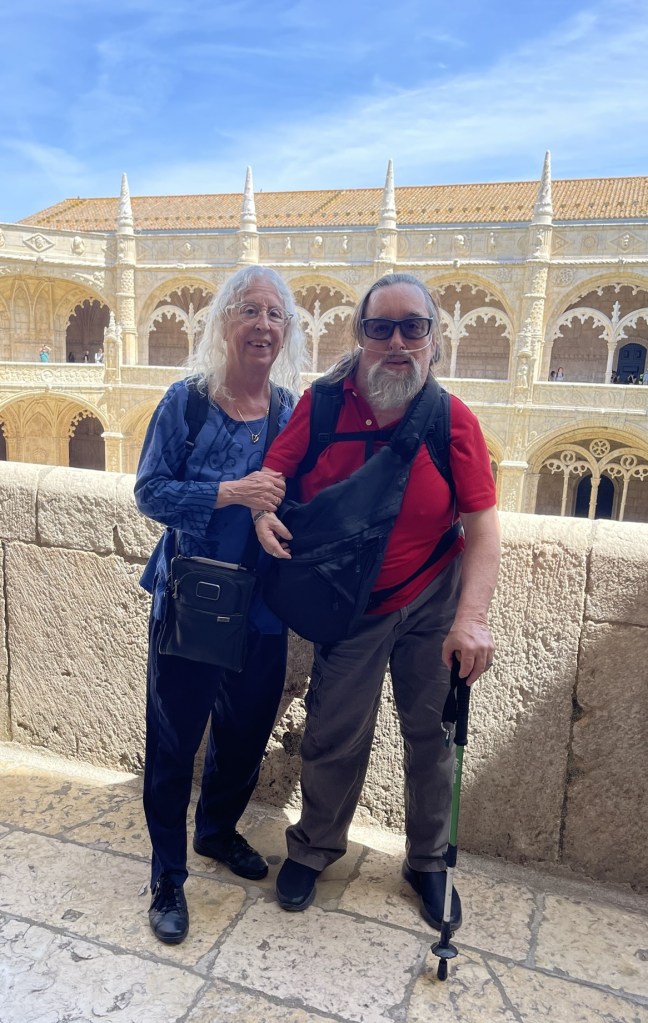
Thomas Hamlett is our guest writer. We thought his suggestions and experience traveling abroad could help others who are considering traveling within the US or internationally. We want to remind everyone to double check with airlines about bringing double batteries on board. Some airlines have a no double battery policy. Also, we want to stress that you should not count on being able to plug your POC in on the plane, even if there are outlets.
I am a 66-year-old who has Restrictive Pulmonary Lung disease (RPLD) brought on by pulmonary scoliosis compression (PSC). It started about 5 years ago full on. Trips to Petra, Jordon (high altitude) & Cambodia’s suffocating heat caused me to see a pulmonologist. I also have Obstructive Sleep Apnea.
I currently use a portable oxygen concentrator (POC) for exertion. At rest I’m fine without it going 92-96% . At night I use a BiPap machine & a continuous flow stationary unit at night at about 2 liters per minute (LPM).
One of my problems is as I got worse, I gained weight and became less active, basically 2300 steps a day. And now I go on a 15-day Istanbul, Cairo & Nile river cruise vacation averaging 8,000 to10,000 or more steps per day. Here are some things I learned over the last three and a half years of traveling with POC oxygen to Chicago, Sacramento, Mexico, Rome, Paris, San Sebastian, Tokyo, Kyoto, and Lisbon, Marseille & Madrid. Hope this will help you.
You can do more than you think you can do. You can’t do what you could do when you were 20, 30, 40 or 50’s so live with it. Pace yourself. Map out what you are going to do each day.
Start Early with your planning with airlines – If you need Special Assistance (wheelchair) do it when you purchase your tickets. If You are slow and/or take many breaks, use a wheelchair. You & your partner will bypass the long lines. It’s iffy with other family members. Madrid airport can take 40+ minutes for an able-bodied person to make a connecting flight. A wheelchair gets you there on time without the stress.
Airlines have different rules for oxygen use on the plane. You can take a portable oxygen concentrator (POC) on a plane, but NOT a tank. Airlines require that you have 150 percent battery life for the flight. So, a 10-hour flight means 15 hours of battery life. When I travel my POC has a double battery. My carry on has my 1 double cell & two single cell batteries. Most international flights have an AC port, but still require 150% battery life. Make sure you also have your European converter out as well. My American 3-pronged cord didn’t fit into the Air France European two prong plug.
If you use an oxygen tank, you cannot use it on the plane. Many airlines will provide you one of theirs upon request. Sometimes at a cost. You can rent tanks where you travel. You just need to do your research where you will be traveling to.
Many airlines want you to fill out a form if you are going to use oxygen. It is usually buried somewhere on their website, FIND IT. Fill it out & send it to them, usually by email. Do it when you purchase tickets. Delta was very easy. Ryan Air, I filled the form out in January, even sending it to my doctor for signature for an April flight. They said I had to resubmit it two weeks before my flight. This last trip was a nightmare coming & going. Got to Los Angeles Airport (LAX) & Turkish Airlines said my doctor’s note had to be within 10 days of the flight, The note was 12 days old. Luckily my doctor emailed me a new letter at the airline. But my trip was 15 days so I had to get a new letter for the return flight. They wouldn’t accept that letter thinking they had to provide the oxygen and no LPM was mentioned.
Security Screenings – Have patience, really have patience. Smile, be cheerful, don’t get agitated, it only makes them work slower. TSA workers the world over are poorly trained when it comes to POCs. Most times you must take your POC off & put it on the conveyor belt to be screened. They see the two silver columns & want to swab them for explosives. My carry on has my BiPap machine, cords & tubing, 3 batteries & charger & other items. An American TSA person said it was too densely packed. I really wanted to tell him he was an idiot but kept my tongue.
The museum bench, or any bench or place to plop down, is your friend, use it – sit, contemplate the works of art & people watch.
Conserving Battery Life – This is totally reliant on what YOU can tolerate. Turning off and on your oxygen depends on your tolerance. For me when I take a cab, train or sitting around in a restaurant or airport I turn off my POC to conserve battery life. If I’m walking from place to place I have it on a setting of 3. When I walk around in a museum I go from a 3 setting to a 2 setting. I have a double cell battery that gets me about 6+ or so hours.
- I have two double cell batteries. As soon as I get back to the hotel, I switch it out & start charging so it’s ready for next day.
- If your hotel uses a card to turn on all the lights in your room, it turns them off when you take it out, including the power outlets. So your chargers will not be charging.
Read the fine print I use a stationary oxygen concentrator at night at home for continuous flow oxygen. I found a company in Lisbon for 4 Euros a night plus 40 euros for delivery & pick-up. We contacted through email & even gave my credit card to them. They came to deliver & we were out exploring Lisbon. They wouldn’t not deliver without me signing for it. I ended up using my pulse POC at night. In Mexico a company delivered & picked with no problems for $150 for 5 nights. Another company wanted 300 & 400 euros in Marseille & Madrid for 5 nights each. Again, I used my pulse POC each night. In Istanbul I found a company for 10 euros a night plus 25 euros for drop off & pick up.

Do your research of locations you plan to visit. Most articles & reviews are written by able bodied people with no eye for obstacles that might make it difficult to traverse. Read TripAdvisor reviews. Sometimes you get clues. Some examples on this trip:
- Pena Palace in Sintra – It is high on a hill. The 434 bus will take you from the train station to the entrance. There is a trolley that will take you to the palace, but that is first a 75 foot walk up hill. When the trolley drops you off you still have a 200 foot walk up a steep incline to where they take your ticket, AND then a couple of flights of stairs to get to the start of the tour. Only a couple of TripAdvisor reviews talked about this.
- Marseille Stadium – Thrilled to get tickets to a Europa Legue soccer game. I did not do research on the stadium. Not a damned escalator or elevator. 20 flights of stairs. At least my ticket was at mid-field. Had a great experience that almost killed me.
- Istanbul Hotel – Nowhere did it mention that it was in a pedestrian only area and you have to call for a golf cart to pick you up.
Many places do not have elevators – Check with your hotel or Air BnB before you go. Especially in apartments. Write DIRECTLY to hotels or apartments to see what they have.
Embrace being Disabled. I am a smaller person with visible disabilities, one arm short, and have my POC and a cane. I have found, more than in the USA, people will want to help you. Almost to being intrusive. Many museum staff will point you to lifts not available to regular guests. Many museums and other tourist spots have discounts or free admissions for those disabled and your caregiver or your spouse. We have saved at least 50 euros so far this trip.
Budget For Extra Costs – If you can find a country you are traveling to that has a nighttime oxygen concentrator there will be a cost. For those unable to walk the 10-20-30 minute walks that you used to before, there are taxis, Ubers & Tuk Tuks. The cost can add up.
On Board the plane – This is where I’ve had the most issues. It has boiled down to small regional airlines & language barriers.
- First, almost all airline staff know that you CANNOT have oxygen cannisters or liquid oxygen on a plane. So, they see you with a POC, they think it’s a cannister. This happened with Air Portugal, Iberra and Ryanair. With Ryanair I had my pulmonologist fill out their form, they approved it, the check-in approved it, but did not transmit that information to the plane’s staff.
- FAA guidelines say that if you have a POC you should sit in the window seat so as to not impede other passengers. Only twice has this been enforced as my wife & I like isle seats. Both times it was Southwest Airlines.
- Basically, you have to, through gestures and words, explain that what you have is not a tank. That it takes from the cabin’s air. I carry a 3×5 card with an explanation of the POC in the languages where I’m traveling to, to make it easier to understand. I use Google Translation.
- English: This is a Portable Oxygen Concentrator (POC). It is NOT an oxygen tank. It takes air from the cabin and filters it into medical grade oxygen,
- French: Il s’agit d’un concentrateur d’oxygène portable (POC). Ce n’est PAS un réservoir d’oxygène. Il prélève l’air de la cabine et le filtre pour en faire de l’oxygène de qualité médicale.
- Spanish: Se trata de un concentrador de oxígeno portátil (POC). NO es una botella de oxígeno. Toma aire de la cabina y lo filtra en oxígeno de grado médico,
- Turkish: Bu bir Taşınabilir Oksijen Konsantratörüdür (POC). Bir oksijen tankı DEĞİLDİR. Kabindeki havayı alır ve tıbbi sınıf oksijene dönüştürür.
- Arabic: ذا هو جهاز تركيز الأكسجين المحمول (POC). وهو ليس خزان أكسجين. فهو يأخذ الهواء من المقصورة ويرشّحه إلى أكسجين من الدرجة الطبية.
 Running On Air